Retirement
How much state pension you will get, how big the gap is and how to provide for your children too.
- State pension
- Workplace pension
- Private pension
- Saving for children
The essentials in three points
- 01The state pension is pay-as-you-go: today's contributions fund today's pensions.
- 02In 2024 there were about 33 people aged 67+ for every 100 aged 20–66. Destatis projects around 45 by 2038.
- 03Time is the biggest lever: every year you start earlier lowers the monthly saving noticeably.
Retirement planning
Plan today for more freedom tomorrow.
What would you like retirement to look like? More time for family, travel or personal projects? A suitable retirement plan helps you prepare financially for those ambitions. Starting early gives your investments more time to grow.
Expavigate helps you understand your existing pension entitlements, identify potential shortfalls and build a plan that fits your life.
Why additional retirement savings matter in Germany
Germany's statutory pension operates mainly on a pay-as-you-go basis. Contributions from today's employees and employers, together with federal funding, finance current pension payments. Your contributions generally do not accumulate in a personal investment account. Instead, they establish entitlements to future benefits. Source: Deutsche Rentenversicherung
Germany's population is ageing. In 2024, there were approximately 33 people aged 67 or older for every 100 people aged 20–66. Under its moderate scenario, the Federal Statistical Office projects around 45 by 2038. These are population ratios, not actual counts of pension contributors and recipients. Source: Destatis
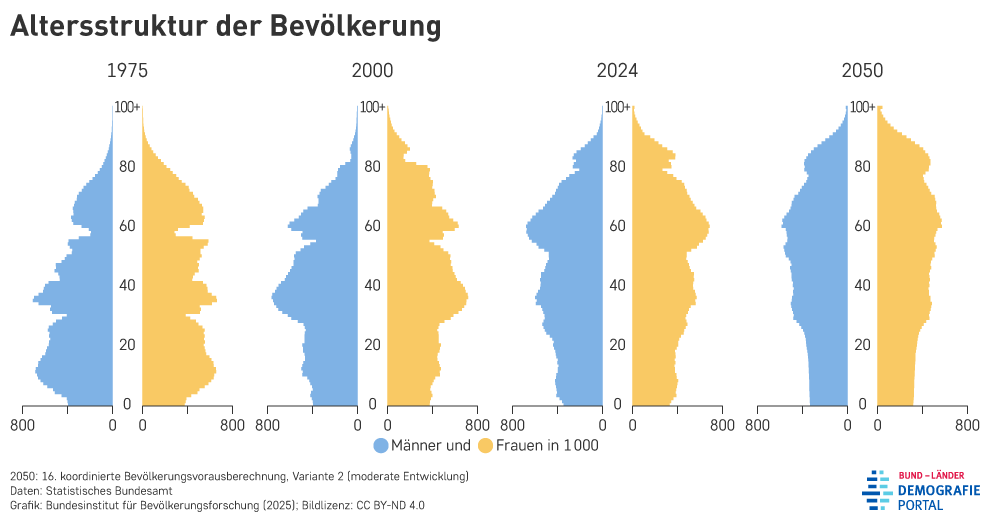
This creates financing pressure. Employment, wages, government funding and policy decisions also influence the system's future. For your personal planning, the practical question is: what income can you expect in retirement, and what lifestyle would you like it to support?
Your pension statement provides an important starting point
The German pension information letter, known as the Renteninformation, highlights the potential need for additional retirement provision. It also explains why purchasing power matters. The pension amounts shown are generally gross figures, so applicable deductions and taxes need to be considered. Source: Deutsche Rentenversicherung, “Altersvorsorge”, chapter 5
We review these entitlements alongside workplace pensions, private plans and other assets. For internationally mobile clients, we also consider existing arrangements abroad and where you expect to live in retirement, involving specialist tax advisers where needed.
Time can make a substantial difference
When investment returns remain invested, they can generate further returns. This is compounding. With funds and ETFs, it comes from investment performance and reinvested distributions; it is not a fixed interest payment.
| Investment period | Calculation | Illustrative final value |
|---|---|---|
| 10 years | €100 × 1.08¹⁰ | €215.89 |
| 20 years | €100 × 1.08²⁰ | €466.10 |
| 40 years | €100 × 1.08⁴⁰ | €2,172.45 |
| 67 years | €100 × 1.08⁶⁷ | €17,353.68 |
Our illustrative calculation assumes one initial investment, full reinvestment and a constant annual return. Values are nominal, before costs, taxes and inflation. Eight percent is a calculation assumption, not a forecast or guarantee. Actual market returns fluctuate, and losses are possible.
Purchasing power matters, especially over long periods. Assuming annual inflation of 2%, the €17,353.68 after 67 years would have purchasing power equivalent to approximately €4,604 today.
You cannot recover the past ten years. You can start planning today.
The right starting point depends on your budget, financial reserves and goals. A manageable monthly contribution can be a worthwhile first step.
Invest regularly, with a plan for changing markets
A fixed monthly investment buys more fund units when prices are lower and fewer when prices are higher. This is known as cost averaging. A regular savings plan also makes it easier to invest consistently from your income.
It does not guarantee profits or better results than investing an available lump sum immediately. A long investment horizon does not eliminate the possibility of losses. Source: Research: Vanguard
Globally diversified equity funds and ETFs provide exposure to many companies. Their value still fluctuates. We therefore align your investment mix with your capacity to take risk and plan ahead for future withdrawals.
Choosing the right retirement savings structure
Private retirement planning can combine several approaches. A fund or ETF investment account offers flexibility. A private pension insurance policy may be relevant when you want a contractual lifelong income. Workplace pension arrangements should also be considered. Source: Overview: BaFin
Tax treatment depends on the structure, eligibility requirements and how benefits are paid. For example, a capital payment and a lifelong private annuity can be taxed differently. Source: German Federal Ministry of Finance
We assess costs, taxes, investment options, flexibility and benefits together. A tax advantage alone does not make a product suitable. Ongoing charges can significantly affect wealth accumulation over decades. Source: BaFin on insurance investment product costs
Expavigate helps you understand your options, build a suitable plan and adapt it as your circumstances change.
Saving for children
An early start can be a gift that lasts a lifetime.
Education, a driving licence or a first home away from the family: growing up brings opportunities and expenses. Starting to save early can help your child take these steps while also building an initial foundation for retirement.
Eligible families receive €259 in monthly German child benefit per child in 2026. If your budget allows after everyday expenses and sufficient reserves, part of this money can be invested. The right amount depends on your family's circumstances. Source: Bundesagentur für Arbeit
Two goals with different time horizons
Money for early adulthood may be needed in 10, 15 or 20 years. As a planned expense approaches, accessibility and lower investment volatility become increasingly important.
A separate portion can remain invested for much longer, with retirement in mind. For example, a €100 monthly savings budget could be allocated as €75 towards early adulthood and €25 towards the longer-term goal. This is an illustration, not a fixed recommendation, and it does not automatically require two separate contracts.
What €25 a month could become over time
Imagine investing €25 at the end of each month from your child's birth until their 18th birthday. Your total contributions would be €5,400. The accumulated investments then remain invested for another 49 years until age 67, without further contributions or withdrawals.
| Assumed annual return | Investment value at age 67 | Purchasing power assuming 2.5% annual inflation |
|---|---|---|
| 6% | approximately €165,503 | approximately €31,645 |
| 8% | approximately €505,552 | approximately €96,664 |
| 9% | approximately €879,571 | approximately €168,179 |
Purchasing power is expressed in euros at the time of your child's birth. Our illustrative calculations assume constant effective annual returns with equivalent monthly compounding. Investment values are before costs and taxes; the final column additionally accounts for 2.5% annual inflation over 67 years. Returns are assumptions, not forecasts or guaranteed minimum outcomes. Actual results may differ substantially, and losses are possible.
Starting early gives your child a valuable head start. Even small regular contributions can build a meaningful financial foundation over decades. The actual outcome depends particularly on investment performance, costs, taxes and inflation.
The differences demonstrate how strongly the outcome depends on returns and time. Whether the eventual savings will support your child's desired retirement lifestyle needs to be reviewed as their life develops.
Ownership also matters. Money invested in an account in your child's name belongs to them. At 18, they can generally decide how to use it. A child-owned account therefore does not, by itself, ensure that the money remains invested until retirement. Source: Verbraucherzentrale
Together, we can develop an affordable plan that supports your family today and gives your child more choices tomorrow. Helping them understand money as they grow is part of that foundation.

Contact
Talk to us.
Tell us briefly what it's about. We get back to you within one business day to find a time: 30 minutes by video, phone or WhatsApp, free of charge.
- Free first call
- In English or German
- Your calculator results as a starting point
- Reply within one business day